Overview
Carbon Trading Essentials: Navigating Compliance, Strategies, and Achieving Net-Zero Summit-Masterclass
SYNOPSIS OF WORKSHOP
As climate change accelerates, carbon trading is gaining global traction as a key mechanism for reducing emissions. An increasing number of countries are establishing their own carbon markets, underscoring the growing importance of market-based solutions in advancing global climate goals. The adoption of Article 6 of the Paris Agreement has further enabled cross-border collaboration through carbon markets, allowing countries to meet their respective Nationally Determined Contributions (NDCs) more effectively.
This workshop offers a foundational yet comprehensive exploration of the core principles of carbon markets, including compliance and voluntary systems, emissions trading mechanisms, carbon credits, offsets, and relevant regulatory frameworks. Participants will examine the lifecycle of carbon projects, key trading platforms, and corporate strategies for managing emissions and aligning with net-zero objectives.
Through expert-led sessions and real-world case studies, the program equips professionals from both the public and private sectors with the knowledge needed to navigate carbon markets, mitigate risks such as greenwashing and double counting, evaluate trading strategies, build compliance readiness, and integrate carbon pricing into their sustainability strategies.
Prerequisite:
No prerequisite to attend this workshop
Learning Time:
24 hours (3 days)
CICPD Credits:
12
Credential:
Certificate of Competency
LEARNING OUTCOMES (LO)
Foundations of Carbon Markets, ETS, and Climate Policy Instruments
- Comprehend the concept of carbon pricing and its function in climate policy.
- Understand the principles of emissions trading, including how it reduces climate pollution.
- Describe emissions trading systems (ETS): Cap-and-Trade vs. Baseline-and-Credit.
- Learn about the components and features of Emission Trading Systems (ETS), such as emissions allowances, compliance, auctions, trading of offsets, and abatement measures.
- Understand the Kyoto Protocol's market mechanisms: Emission Trading, Clean Development Mechanism (CDM), and Joint Implementation (JI).
- Understand CERs (Certified Emission Reductions) and ERUs (Emission Reduction Units) under CDM and JI.
- Understand Article 6 and the role of Internationally Transferred Mitigation Outcomes (ITMOs) in cross-border trading.
- Define CO₂ allowances, carbon credits, and carbon certificates.
- Define Offsets and Allowances and their roles in both the Voluntary Carbon Market and Compliance Carbon Market.
- Differentiate carbon credit standards: Gold Standard vs. Verra Verified Carbon Standard (VCS).
Carbon Market Mechanics, Trading Dynamics, and Risk Management
- Learn about the stakeholders involved in ETS trading and how to collaborate effectively.
- Understand how policy design choices can influence program results in ETS, and the impact of different design parameters on market outcomes.
- Evaluate carbon credit integrity, additionality, permanence, leakage, and co-benefits, ensuring alignment with UN SDG #13 and climate action goals.
- Understand the full lifecycle of carbon project development—from concept, validation, and verification to issuance and trading of carbon credits.
- Identify potential risks in carbon trading, including greenwashing, double counting, and regulatory uncertainty, and develop mitigation strategies.
- Case study of successful carbon trading initiatives and their impact on emissions reduction.
Strategic Application, Corporate Action, and Performance Assessment
- Identify Scope 1, 2, and 3 emissions, and explain the corporate emissions reporting framework.
- Apply abatement strategies for net-zero goals, considering when to trade offsets and allowances.
- Learn to develop and implement a carbon portfolio management strategy.
- Understand Nature-based Solutions (NbS) and Technology-based Solutions (TbS) in context of the Paris Agreement.
- Understand legal frameworks relevant to carbon pricing schemes.
- Understand current trends and the legal and regulatory frameworks that govern carbon pricing and trading at global, regional, and national levels.
- Apply various carbon pricing mechanisms across different contexts and industries, including Carbon Tax, ETS, CBAM, and Social Cost of Carbon.
- Acquire the ability to evaluate the performance of facilities and the overall ETS system, including assessing emissions, market activity, funds raised, offsets used, and penalties assessed.
- Develop a roadmap for integrating carbon pricing and trading into an organization's sustainability strategy to achieve net-zero targets.
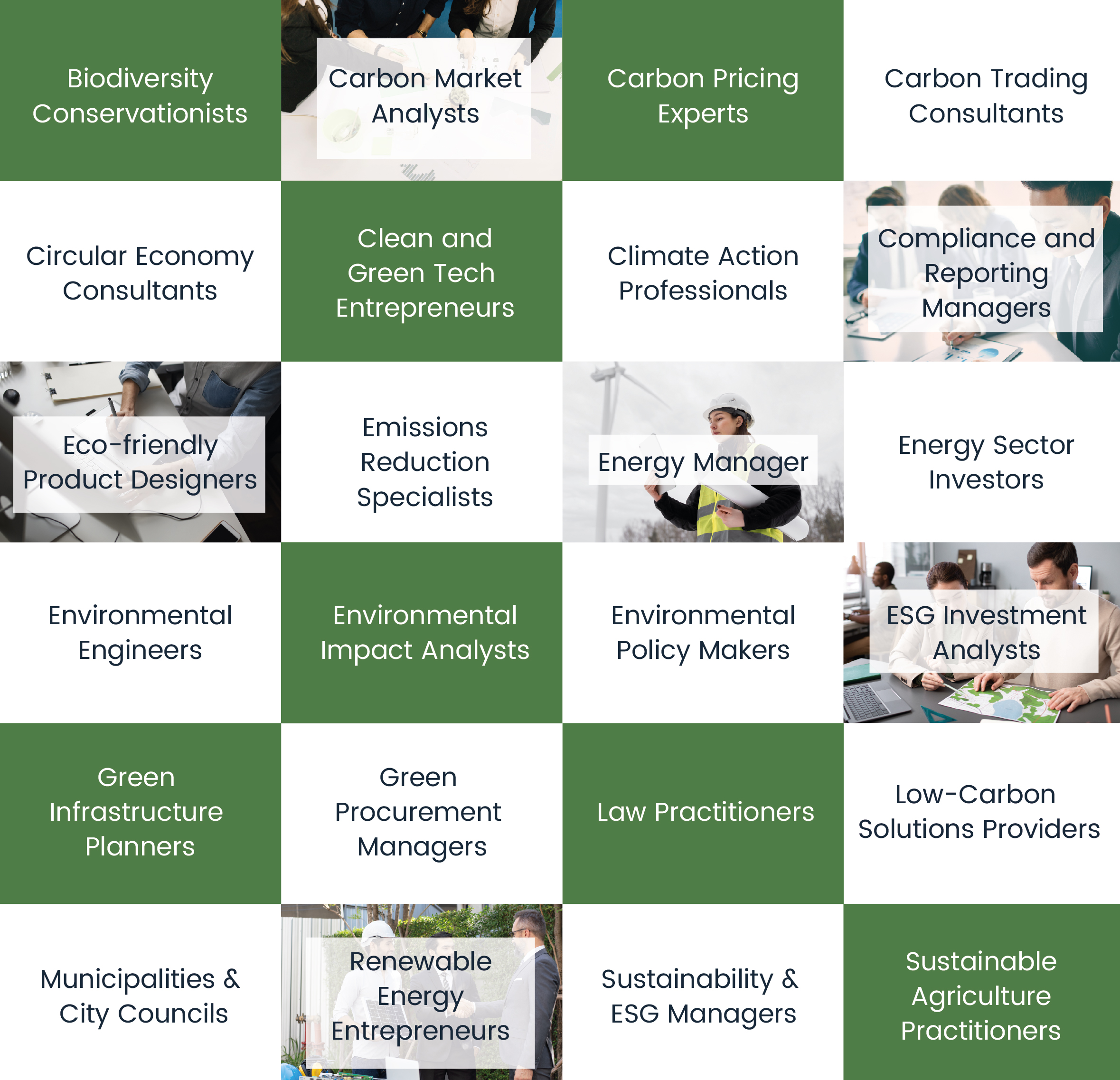
WHO SHOULD ATTEND